


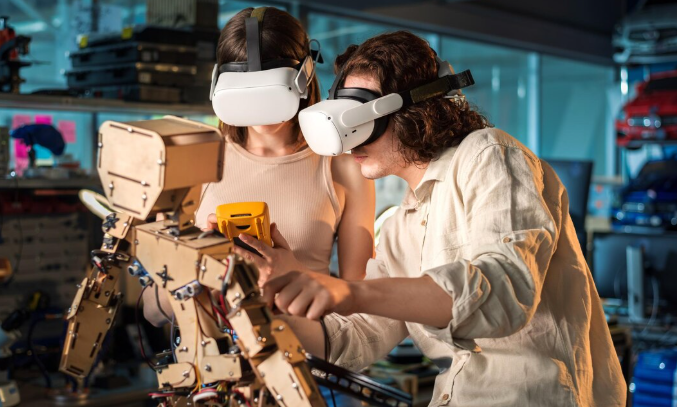
A big concrete structure hums softly from dawn until well after midnight on the outskirts of Shanghai, where warehouses stretch toward the mist of far-off apartment buildings. Inside, dozens of humanoid robots repeatedly practice routine tasks like folding shirts, opening doors, and stacking plastic containers. As the scene develops, it nearly resembles a futuristic factory. However, if you look more closely, you can see that each robot has a human standing next to it.
These training facilities, sometimes referred to as data factories, are now an essential component of China’s artificial intelligence boom. Businesses such as AgiBot run facilities where robots carry out repetitive tasks for hours every day under the supervision of human operators. The goal is straightforward: collect enormous volumes of real-world data so the machines can eventually complete the tasks independently.
| Category | Details |
|---|---|
| Country | China |
| Example Company | AgiBot |
| Major Cities Involved | Shanghai, Shenzhen, Beijing |
| AI Focus | Humanoid robots and embodied AI systems |
| Typical Training Method | Human-guided robot training and data labeling |
| Estimated Government Funding | Over $20 billion in robotics and AI initiatives |
| Training Facilities | Data-collection warehouses and robot testing factories |
| Key Challenge | Generating real-world data to train robots |
| Workforce Impact | Millions of manufacturing jobs potentially affected |
| Reference Source | https://www.reuters.com/technology |
For years, Silicon Valley software engineers and stunning demonstrations of humanoid robots performing backflips have shaped the public’s perception of artificial intelligence. Attention is drawn to those moments. However, behind the scenes, a massive labor pipeline silently supplies these systems with the data they require to operate. That pipeline is being industrialized in China.
The atmosphere is strangely repetitive when you enter one of these training warehouses. Polished concrete floors reflect fluorescent lights. After every test, workers stand next to robots that are holding tablets, pressing commands, and resetting objects. A cup is picked up by a robot. It is put back down by a human. Once more. And once more. For seventeen hours a day, at times. Efficiency in the conventional sense is not the aim. It’s information.
Robots need to comprehend the physical world, in contrast to language models that can learn from billions of online texts. They require illustrations of how a hand holds a screwdriver, how a box tilts when raised, and how a door handle rotates. Human demonstration is needed to collect that data; thousands or even millions of repetitions are recorded as training data.
There is an odd irony as you watch this process take place. Frequently, the machines seem self-sufficient. They are actually surrounded by people.
These initiatives are viewed as strategic by the Chinese government. In an effort to increase the nation’s manufacturing advantage, officials have invested billions of dollars in robotics and artificial intelligence initiatives. Local governments in places like Beijing and Shenzhen provide research grants, office space, and subsidies to robotics startups that are experimenting with humanoid machines. Investors appear certain that the risk may be profitable.
According to some analysts, humanoid robots may eventually take the same route as electric cars, which are initially costly but quickly become less expensive as production expands. According to early projections, the cost of building a humanoid robot could drop significantly over the course of the next ten years, particularly if the majority of the parts are sourced from China’s supply chain.
There are about 123 million manufacturing workers in China. The labor market may change in unexpected ways if many factory tasks are eventually mastered by robots. Legislators have started debating concepts like “AI unemployment insurance,” a suggestion that shows how seriously the problem is being taken. Whether those worries are premature is still up for debate.
The robots are still awkward trainees inside the training warehouses. A humanoid might misjudge a package’s weight or drop a cup. The machine is guided through another attempt by workers who carefully reset the experiment. The kind of improvement that only becomes apparent after months of repetition is steady but slow.
Observing the process gives the impression that human patience is still a major component of artificial intelligence.
With every training session, the paradox becomes more apparent. The machines need more data as they get more sophisticated. Additionally, the amount of human labor required to generate the data increases with its requirements. In this way, the AI economy reorganizes labor—moving workers from assembly lines to data lines—rather than replacing it.
As of right now, the warehouse floors are still packed with workers adjusting sensors and guiding metal limbs. Outside, Shanghai’s skyline is illuminated by a gentle mist, with cranes scattered like robotic birds along the horizon. Inside, robots keep practicing the same basic movements while gradually picking up new skills from the people standing next to them.
The contradiction is difficult to ignore. The factories may eventually be run by machines. However, the factories are still operated by human workers, at least for the time being.
