


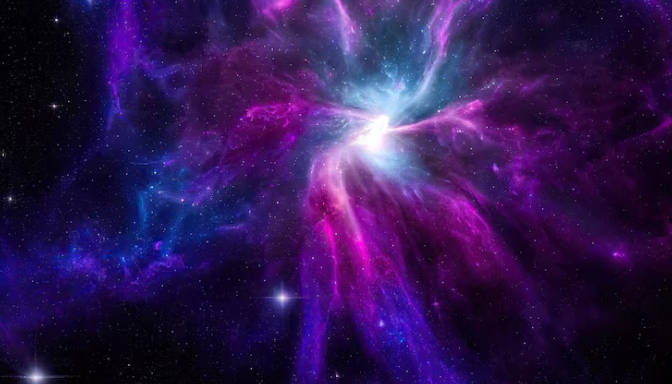
The night sky appears serene at first glance. A scattering of silent stars. a constant glow from far-off galaxies. However, astronomers are aware that serenity can be deceiving. A star is probably dying spectacularly somewhere in that darkness, exploding in a cosmic event so brilliant that it can briefly rival the light of an entire galaxy.
We refer to this phenomenon as a supernova. For what is essentially a stellar disaster, it sounds almost courteous. A massive shockwave bursts outward in a matter of seconds as a star collapses, its core imploding due to its own gravity. As much energy as the Sun could produce over billions of years is released in the ensuing flash. There is an odd sense that the universe occasionally favors drama when observing the data streams from telescopes.
| Category | Details |
|---|---|
| Phenomenon | Supernova / Superluminous Supernova |
| Scientific Field | Astrophysics |
| Cause | Collapse of massive star or runaway nuclear fusion in a white dwarf |
| Peak Brightness | Can briefly rival or exceed the brightness of an entire galaxy |
| Typical Frequency | In the Milky Way roughly once every 60–100 years |
| Energy Released | Comparable to the Sun’s total lifetime energy in seconds |
| Remnants | Neutron star, magnetar, black hole, or expanding nebula |
| Notable Example | ASASSN-15lh (one of the most luminous known explosions) |
| Key Instruments | Las Cumbres Observatory, ATLAS Survey Telescope |
| Reference | https://en.wikipedia.org/wiki/Supernova |
Only a tiny percentage of the hundreds of billions of stars that make up most galaxies will ever explode in this manner. Even so, it’s difficult to ignore the explosions that do happen. For a brief period, even ordinary supernovae can shine as brightly as billions of suns put together. That abrupt appearance—a new point of intense light where none previously existed—has an unsettling quality for astronomers scanning telescope images late at night.
Some of these occurrences are even more severe. These days, scientists refer to them as “superluminous supernovae.” Although the name sounds technical, the actual situation is nearly ludicrous. A single dying star can suddenly outshine the entire galaxy it lives in. That one explosion might become the brightest object in its host galaxy from millions or even billions of light-years away.
One such cosmic explosion that occurred about a billion light-years away from Earth was recently studied by scientists. The ATLAS survey telescope in Chile and the Las Cumbres Observatory network provided the data. Over several months, the explosion’s brightness curve exhibited peculiar behavior, rising, dipping, and then rising once more. For weeks, astronomers gazed at the graphs, attempting to determine precisely what they were witnessing.
They believe that a magnetar, which is even stranger than the explosion itself, holds the key to the explanation. A neutron star, which is so dense that a teaspoon of its material would weigh billions of tons, can form from the remnant core of a massive star that collapses. That neutron star occasionally produces a magnetic field trillions of times stronger than Earth’s while spinning hundreds of times per second.
The expanding cloud of debris may receive energy from that rotating magnetar, increasing the brightness of the explosion. The gas released by the dying star collides with charged particles that shoot outward. Long after the initial blast, the supernova becomes brighter due to a sort of cosmic feedback loop. Some of these events may become so ridiculously bright because of this process.
It’s difficult to ignore how fleeting these moments are when standing outside on a clear night. After blazing for weeks or months, a supernova may fade into a faint, expanding nebula. The final explosion is nearly embarrassingly brief when compared to the millions or billions of years the star burned silently.
The story has an unsettling aspect as well. Supernovae are more than just fireworks. The universe is altered by them. Sometimes the shockwaves cause completely new stars to form by pushing gas and dust across interstellar space. Numerous heavy elements that are present in both human bodies and planets were created inside stars that eventually exploded. It seems as though these violent deaths are also acts of cosmic recycling when one watches the physics play out on a computer screen.
Scientists believe that thousands of supernovae happen annually throughout the observable universe. The majority are invisible to the human eye and are only picked up by automated telescopes that silently compare pictures of far-off galaxies. Sometimes, however, one is so bright that it attracts attention right away, illuminating observatory control rooms all over the world.
Whether scientists fully comprehend the brightest explosions is still up for debate. Even record-breaking incidents, such as the well-known ASASSN-15lh, have generated controversy. Some scientists contend that they may actually be stars being ripped apart by black holes rather than supernovae. There is a lot of room for doubt because the evidence is inconsistent.
It seems as though the universe purposefully keeps some secrets out of reach as the research progresses. Another peculiar light curve emerges each time astronomers believe they have a better understanding of these explosions. Unpredictably, another star explodes.
And somewhere out there tonight, a star might already be collapsing, its magnetic fields twisting space as its core crushes inward, ready to release a flash of light so intense that it briefly outshines an entire galaxy.
