


Not too long ago, monarch butterflies were so abundant that they caused the branches of California’s coastal pines to bend. The way the orange clusters resembled fruit hanging from the trees and the gentle sound of millions of wings shifting all at once are still talked about by locals along the central coast. Now, that image has mostly vanished, to be replaced by something much more subdued and depressing. Less than 2,000 butterflies were counted in the west last winter, which almost seems like a typo.
Although it may seem that way at times, the collapse did not occur overnight. Every fall in the 1990s, almost 700 million monarchs made the arduous journey south. Over the course of two decades, the eastern population—which still contains roughly 99% of the continent’s monarchs—has decreased by more than 80%. The most recent overwintering count from Mexico was 2.10 hectares of occupied forest, which is significantly less than the six-hectare threshold that scientists claim is necessary to keep the species safely outside of the danger zone. The figures are not good. It’s a worse trajectory.
| Detail | Information |
|---|---|
| Common Name | Monarch Butterfly |
| Scientific Name | Danaus plexippus plexippus |
| IUCN Red List Status | Endangered (since July 2022) |
| Native Range | North America (Canada, United States, Mexico) |
| Migration Distance | Up to 4,000 kilometres annually |
| Eastern Population Decline | Over 80% in the past two decades |
| Western Population Decline | Around 99.9% since the 1980s |
| Main Host Plant | Milkweed (Asclepias species) |
| Overwintering Sites | Oyamel fir forests in central Mexico; coastal groves in California |
| Key Threats | Habitat loss, pesticides, climate change, illegal logging, tropical milkweed |
| Conservation Petition Filed | 2014 (U.S. Fish and Wildlife Service) |
When you speak with researchers, the word “tragedy” keeps coming up. David James of Washington State University, who has tracked monarchs for years both here and in Australia, has noticed something odd: the migration collapse he witnessed there is now occurring here. He believes tropical milkweed is involved. It’s the kind of plant that well-meaning gardeners purchase from the nursery without realizing that it remains green throughout the winters that used to kill it back, encouraging butterflies to breed locally rather than travel a long distance. The same plant is also associated with a parasite problem. Little decisions have big repercussions.
Climate change complicates matters even more. Drought in the breeding grounds, warmer winters in California, abrupt temperature fluctuations that disrupt the timing of migration before the milkweed is ready—it all adds up. Even experts don’t seem to agree on whether winter-breeding is the root of the collapse or just a symptom. It’s possible that the monarchs of the West are subtly changing their own life cycles in order to adapt to a society that no longer values the traditional four-thousand-kilometer flight. That would be amazing. Additionally, it would imply that the migration—which is what made monarchs famous—is simply coming to an end.
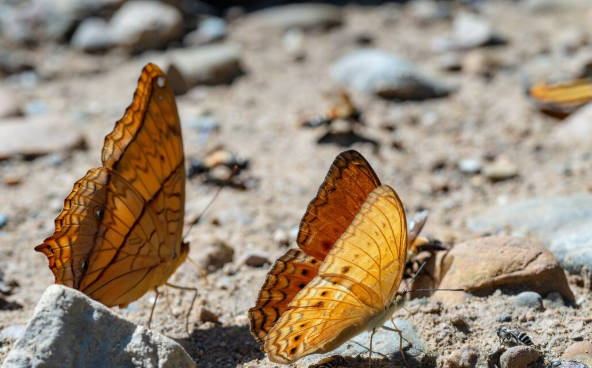
In July 2022, the migratory monarch was officially listed as Endangered by the IUCN. In December, the Fish and Wildlife Service in the United States placed the species on a waiting list for full protection under the Endangered Species Act. However, as the Center for Food Safety noted at the time, this decision came with no real protections. Since 2014, conservation organizations have been requesting actual protection. The wait is still ongoing.
It’s difficult to ignore the impression that monarchs are taking on a more significant role as this develops. Development and herbicide-resistant crops have already destroyed an estimated 165 million acres of breeding habitat. Once a roadside annoyance, milkweed is becoming less common. Community plantings, a decrease in pesticide use, and citizen science are examples of signs of hope, according to Anna Walker, who oversaw the IUCN’s monarch assessment. Perhaps that’s sufficient. Perhaps it isn’t. In any case, the butterflies that pass through a Pismo Beach grove the following winter will be a diminutive, unfamiliar relic of what once astounded you.
