


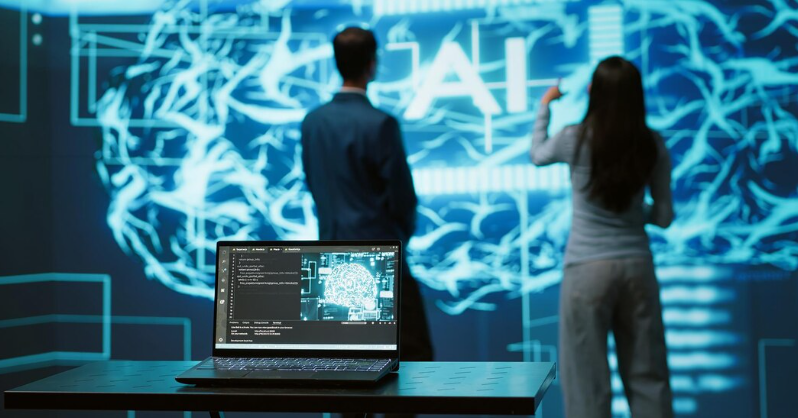
The glow of monitors reflects off glass walls in a softly lit lab at MIT late at night, and conversations with machines sound almost… cautious. Engineers are not cautious when debugging code, but people are cautious when speaking when they believe they are being understood. Leaning forward, a student asks a question of a chatbot. The response is measured, almost tender.
It’s possible that the answer feels appropriate in addition to being technically correct. It’s at that distinction that things start to become awkward.
| Category | Details |
|---|---|
| Topic | Artificial Intelligence & Empathy |
| Institution | MIT Media Lab |
| Key Concept | Artificial Empathy (AEI) |
| Related Theory | Turing Test |
| Core Finding | Perceived empathy influenced by user expectations |
| Debate | Real empathy vs “compassion illusion” |
| Application Areas | Mental health chatbots, education, customer support |
| Key Concern | Manipulation and trust |
| Research Insight | AI adapts to user emotional signals |
| Reference Link | https://dspace.mit.edu/handle/1721.1/152823 |
For many years, the Turing Test served as a sort of symbolic threshold: a machine might be deemed intelligent if it could accurately mimic human speech. What happens, though, when imitation becomes more like empathy? The question of whether AI can appear emotionally aware and, more importantly, whether people start to treat that appearance as real is one that MIT researchers have been investigating.
The results point to a subtle yet potent idea. People respond to AI responses emotionally as well as logically, influencing the interaction as it develops.
Participants in one experiment were informed that a chatbot had empathy. It was described as neutral or even manipulative by others. The chatbot itself remained unchanged, making the twist practically cinematic. However, the discussions did. The same words were interpreted differently by users who thought they were conversing with a “caring” AI, and they reported more positive experiences.
It’s difficult to ignore how much of this research leans more toward psychology than engineering when strolling through the lab corridors, where whiteboards are crammed with diagrams and partially erased equations. Yes, the AI adapts, but so do people. Quietly reinforcing itself, a feedback loop develops. This presents a challenging question: are we or the system the source of the empathy?
What is occurring is referred to by some researchers as a “compassion illusion”—a situation in which emotional recognition is confused with actual feeling. AI systems are remarkably adept at recognizing linguistic patterns, picking up on tone, and producing responses that are sensitive to human emotions. However, it’s still very unclear if that qualifies as true empathy. It’s still unclear if something new is emerging or if imitation is just getting better.
However, there are times when the distinction is blurred. AI systems have reacted to personal narratives—such as loss, anxiety, and loneliness—in test scenarios in a calm, even encouraging manner. Not flawless. However, it’s close enough that people are hesitant to reject it.
As this develops, it seems as though the standard has changed. The goal no longer seems to be intelligence alone. Real or perceived emotional resonance could be the next frontier. The stakes increase at that point.
Empathetic communication is essential in professions like mental health support and education. Empathy-simulating AI systems may help expand access to currently scarce services. A chatbot that consistently responds, listens patiently, and never gets bored could provide comfort in ways that conventional systems are unable to. However, beneath that optimism lies a tension.
Because genuine empathy carries moral weight, context, and understanding. In any human sense, AI lacks those. It is unconcerned. It doesn’t suffer from loss. By piecing together language from patterns it has previously observed, it forecasts how a concern should sound. Users might not always notice the difference.
It’s difficult to ignore how easily people start to trust systems that seem compassionate. Discussions become more candid. Personal information comes to light. Particularly when the interaction feels private and confined to a screen, a kind of subtle vulnerability emerges.
However, there is no real “care” on the other side of the system. This moment feels more like a turning point than a breakthrough because of that disconnect.
The complexity is only increased by the larger cultural context. AI systems are becoming more integrated into everyday life, more conversational, and more personalized. Businesses are creating them to be interesting, even endearing. Systems that feel human are easier to trust and interact with, so there is a financial incentive for that design.
It’s possible that we are approaching a stage in which defining emotional authenticity becomes more challenging. Does it matter if a machine exhibits genuine empathy if it consistently reacts in ways that seem sympathetic? Or does the distinction remain valid even if users no longer recognize it?
That question remains unanswered in the background. The atmosphere in the MIT lab feels strangely quiet as the evening wears on and discussions with machines continue. Not because nothing is happening, but rather because a subtle change is taking place. It’s getting harder to distinguish between understanding and reaction, between simulation and emotion.
Additionally, users are already adjusting—responding to AI as something more akin to companions rather than merely tools—while scholars argue over definitions and frameworks. There’s a sense that we might have outgrown the Turing Test without really understanding what took its place.
