


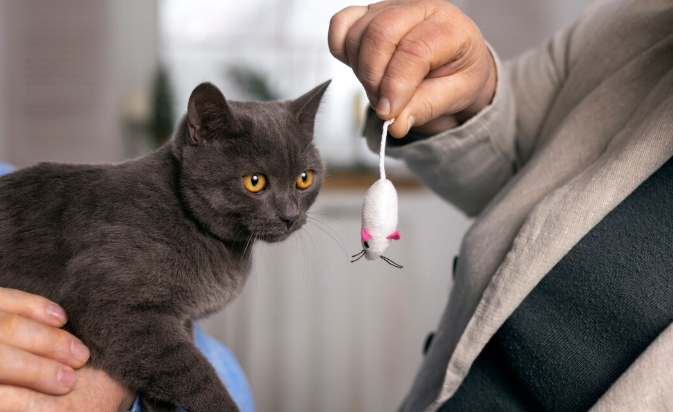
A young undergraduate student is seen holding a cat above a thick, soft cushion in the Laboratory of Veterinary Physiology and Biochemistry at Yamaguchi University in Japan. They are engaging in scientific activity. Presumably, what it appears to be quite different. The cat is let go. What follows is captured in remarkable detail by high-speed cameras. And the footage that results adds yet another chapter to what is unquestionably one of the most peculiar and long-running investigations in the history of physics.
Scientists have been troubled by the falling cat issue since at least 1700. The question is surprisingly straightforward: how does a cat flip itself right-side up and land cleanly on its feet after being dropped from an upside-down position with no initial spin, without going against the laws of physics that state it shouldn’t be able to do so at all? Hannah Fry, a mathematician from Cambridge, pointed out a few years ago that something cannot just begin spinning on its own due to conservation of angular momentum. Apparently, cats did not receive that message.
Key Information: The “Falling Cat” Physics Problem — 2026 Study
| Research Topic | Feline air-righting reflex — how cats self-correct mid-fall |
| Lead Researcher | Yasuo Higurashi — Yamaguchi University, Laboratory of Veterinary Physiology and Biochemistry, Japan |
| Study Published In | The Anatomical Record (February–March 2026) |
| Key Finding | Thoracic (upper) spine is highly flexible; lumbar (lower) spine acts as a stiff anchor — enabling sequential rotation |
| Thoracic Spine Flexibility | Can twist up to ~360 degrees; features a low-resistance “sweet spot” at ~50 degrees of twist |
| Methodology | Spines removed from 5 donated cat cadavers; high-speed video of 2 live cats dropped 8 times each onto padded surface |
| Rotation Sequence | Anterior (upper) trunk rotates first, posterior (lower) trunk follows — not simultaneous |
| Surprising Side Finding | Both live cats showed strong right-turn bias — one turned right every single time |
| Historical Start of Problem | Scientists debating the mechanism since at least 1700; Étienne-Jules Marey’s photographs in 1894 first confirmed the reflex photographically |
| Four Major Theories (Historical) | “Tuck and Turn” (Guyou/Marey), “Falling Figure Skater” (James Clerk Maxwell), “Bend and Twist,” “Propeller Tail” (Giuseppe Peano) |
| Leading Physics Commentator | Greg Gbur, University of North Carolina Charlotte — author of Falling Felines and Fundamental Physics |
| Unresolved Question | Full 3D motion analysis still needed; individual variation between cats means no single universal mechanism confirmed |
In 1894, the French physiologist Étienne-Jules Marey published high-speed photos of a falling cat that landed squarely on its feet, bringing the controversy to light. The Academy of Sciences in France was unimpressed. The images, according to one participant, are a scientific paradox that directly contradicts basic mechanical principles. People who had probably spent their entire lives watching cats fall from objects effectively told Marey that he was mistaken. The pictures were accurate. The Academy felt ashamed. Since then, the argument has continued.
The new Yamaguchi study is intriguing because it has discovered something structural and quantifiable that earlier research had mostly speculated about, rather than because it asserts that it has found a definitive solution to the issue. Five donated cat cadavers’ spines were gathered by researcher Yasuo Higurashi and associates, who preserved the ligaments and discs before physically twisting the sections in a machine to gauge the amount of resistance each area provided.
They discovered a distinct and significant difference between the lumbar and thoracic regions of the spine. Around the 50-degree mark, the thoracic region twists remarkably easily and offers virtually no resistance. This is a sort of mechanical sweet spot where the spine essentially cooperates with the rotation. In contrast, the lumbar area is much stiffer and serves as an anchor around which the upper body can freely swing.
The team contends that this explains why falling cats rotate in a sequential fashion rather than all at once, with the rear twisting into place after the front. The lower body is following the upper body’s lead. This was evident in the high-speed photos of the two live cats: one rear leg extended for leverage, front paws tucked, anterior trunk rotating first, and posterior trunk following. Watching the video in slow motion makes it appear less like a defiance of physics and more like a very sophisticated mechanical solution that evolution came up with long ago and never bothered to promote.
After reading the Yamaguchi paper, Greg Gbur, a physicist at the University of North Carolina, Charlotte, who has spent years researching this particular issue and wrote a book on the topic, found himself changing his own conclusions. He had maintained for years that the most basic mechanism at play was likely the “bend and twist” model, in which the cat bends at the waist and rotates its upper and lower halves in opposite directions. Marey’s own circle had put forth the older “tuck and turn” explanation back in 1894, but it had fallen somewhat out of favor. The new findings have forced him to give it more weight. The first serious hypothesis may have been closer to the truth than the field realized, despite being rejected and then rehabilitated several times over the course of more than a century. This is a subtle irony.
The live-cat experiments yielded one unexpected result. Both of the two cats in Yamaguchi who were dropped onto that cushion eight times apiece demonstrated a strong preference for turning to the right. Every time, one made a right turn. Six out of eight was achieved by the other. Gbur’s best theory, which is intriguing but completely unproven at this time, is that some asymmetric internal organ placement might make one direction slightly easier.
There’s a subtle beauty to the fact that this question remains unanswered. The complete solution is still elusive despite three centuries of physicists, physiologists, photographers, and one extremely patient group of Japanese researchers. Gbur has noted that true three-dimensional analysis is impossible because all of the high-speed footage that has been collected thus far comes from a single angle. He believes that a multi-angle setup would show things that the existing data just cannot. For their part, the cats have probably always known how to do it. Simply put, they have refused to provide an explanation.
