


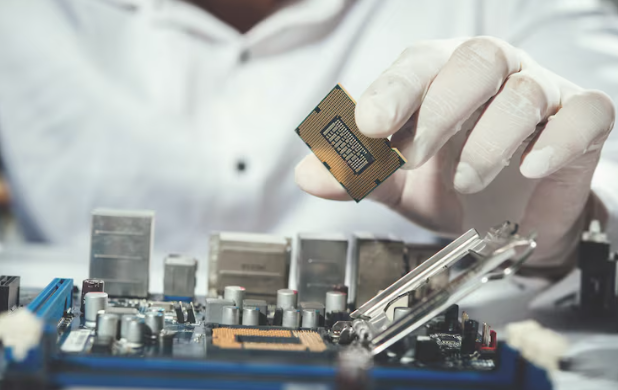
Some of the most significant items in the world are manufactured in a facility in Hsinchu, Taiwan, which is a component of an expansive complex of factories that operate 24/7. They are invisible without a microscope. Each one is a fingernail-wide chip that contains billions of tiny transistors. The manufacturer, Taiwan Semiconductor Manufacturing Company, which most people just refer to as TSMC, is valued at $1.76 trillion. It produces processors for Qualcomm, Broadcom, Apple, AMD, and Nvidia. To put it another way, a chip manufactured in one of those Taiwanese factories made it possible for you to unlock your phone this morning, ask an AI chatbot a question, or watch a movie.
This is the tale of how semiconductor companies have surreptitiously emerged as the world’s most valuable enterprises. Not because silicon and circuit boards suddenly became popular. However, the advent of AI, which depends only on chips, put the companies that create and manufacture those chips in a situation that no one could have imagined ten years ago. In 2025, Nvidia briefly held the title of most valuable firm in the world, with a market capitalization of over $4.5 trillion. That exceeds the whole economic production of the majority of nations. It is a truly peculiar kind of success for a company that began producing graphics cards for video games in the 1990s.
Key Information: Global Semiconductor Industry (2026)
| Field | Details |
|---|---|
| Industry Size (2026 est.) | ~$600 billion global market, approaching $1 trillion with AI |
| Nvidia Market Cap (2026) | ~$4.5 trillion (briefly world’s most valuable company) |
| TSMC Market Cap | ~$1.76 trillion (6th most valuable public company) |
| TSMC Foundry Market Share | ~72% of global foundry market; 90%+ of advanced chip production |
| TSMC Revenue Growth (2026) | Expected ~30% year-over-year |
| TSMC Capital Investment (2026) | ~$45–56 billion in fab expansion |
| Nvidia GPU Market Share | ~90% in AI accelerator chips |
| AI Chip % of Total Revenue | AI chips = less than 0.2% of chip volume but ~50% of industry revenue |
| Top Companies | Nvidia, TSMC, ASML, AMD, Broadcom, Qualcomm, Samsung |
| Key Geopolitical Risk | Taiwan Strait tensions; U.S.–China export controls |
| U.S. Policy Response | CHIPS Act — billions invested in domestic chip manufacturing |
| Reference Website | Semiconductor Industry Association |
It all boils down to one very basic fact. A significant amount of processing power is needed to train a large AI model, such as the one that powers ChatGPT, Google Gemini, or Claude. not standard processing power. specialized processing power capable of doing millions of calculations concurrently and in simultaneously. GPUs from Nvidia are designed specifically for this purpose. Nearly every significant AI system in the world is powered by Nvidia technology, as the company holds a 90% market share in the AI accelerator chip industry. Although they make up less than 0.2% of all chip units, AI chips are responsible for about half of all semiconductor industry revenue. That ratio is exceptional. Nearly half of the money is carried by a small portion of the product.
Silently, TSMC sits in the middle of it all. TSMC actually manufactures the real chips, not just for Nvidia but for nearly everyone, even though Nvidia receives the media attention. The business holds 72% of the worldwide market for semiconductor foundries, and that percentage rises to over 90% for sophisticated circuits smaller than 7 nanometers. As a result, a very unique type of business is created. TSMC doesn’t compete with its clients. It simultaneously produces processors for AMD and Nvidia. For Qualcomm and Apple. for the special AI processors made by Google. It is the arms dealer in the AI race, selling to all sides, according to one observer. In 2026, TSMC anticipates that revenue would increase by over 30% year over year due to a significant gap between supply and demand. This year alone, the corporation is investing between $45 and $56 billion to expand its capacity.
The immense geopolitical stakes involved in all of this are difficult to ignore. Taiwan is located roughly 100 miles away from China’s mainland. In a move that would have appeared drastic five years ago, the governments of the United States and China have both made semiconductor production a national priority. Because so much of the world’s most advanced chip production is centered on one little island that China claims as its own, the U.S. CHIPS Act was created expressly to bring advanced chip manufacturing back to American territory. Several governments now view ASML, the Dutch business that produces the machinery needed to produce the most sophisticated chips—the only company in the world capable of doing so—as vital infrastructure.
Europe does not wish to lose it. The United States does not either. These corporations are sporting valuations that are uncommon historically. The question of whether the AI boom had driven prices too far, too quickly, was raised by Nvidia’s trading at the kinds of multiples it reached in late 2025. Even as TSMC invests billions to satisfy rising demand, the company’s leadership has cautioned about possible AI bubble concerns. If spending on AI slows down or if a big cloud firm chooses to produce more of its own chips instead of purchasing from Nvidia, there is real uncertainty about what will happen. AMD is already providing a reliable substitute at a reduced cost. Silently, Google, Amazon, and Meta are developing their own AI CPUs. If it is a monopoly, it might not endure indefinitely.
But for the time being, everything revolves on the companies that design and manufacture semiconductors. each new data center that is constructed. Energy, security, and technological competitiveness were concerns shared by all governments. On a server farm, every AI model is being trained. They are all powered by chips. And the corporations that produce those chips, with offices in Santa Clara, Taipei, and Eindhoven, are currently the most significant enterprises in the world.
