


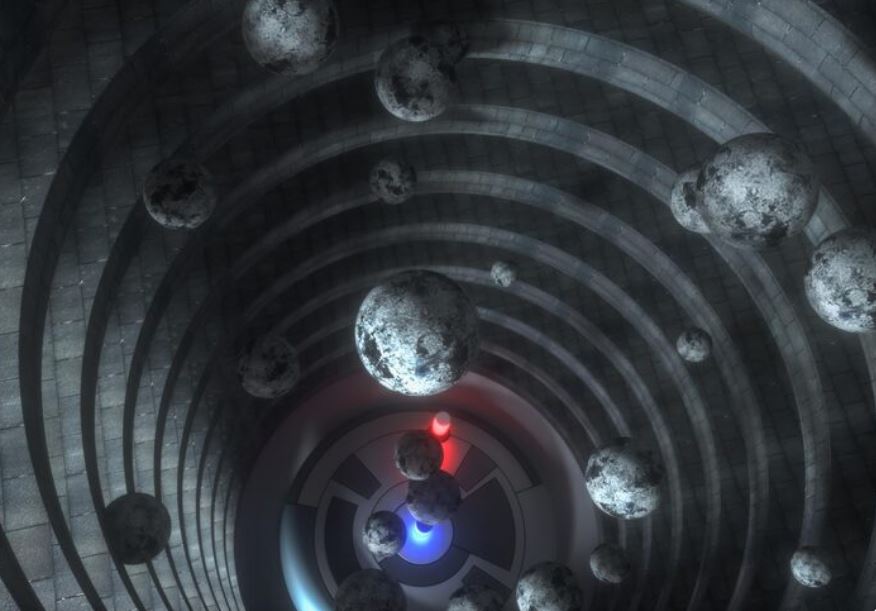
The sky appears surprisingly straightforward on a chilly night away from city lights. A faint Milky Way band, a scattering of stars, or perhaps a satellite moving silently overhead. However, behind that serene vista is a structure so expansive and intricate that even contemporary cosmology finds it difficult to explain. Current models suggest that the universe is like a cosmic web, with threads of galaxies spanning unfathomable distances and separated by voids. It sounds neat. It’s completely different in practice.
These patterns have been mapped by astronomers for decades, using the faint light that galaxies left behind billions of years ago to create three-dimensional charts. The information points to a complex structure that resembles the skeleton that holds the universe together. However, a large portion of it is still invisible. The structure seems to be dominated by dark matter, which cannot be directly observed. By observing galaxies move in unexpected ways due to gravitational effects, scientists deduce its existence. We seem to be drawing outlines without ever seeing the actual thing, tracing shadows instead of actual objects.
| Category | Details |
|---|---|
| Topic | Structure of the Universe |
| Key Concept | Cosmic Web, Dark Matter, Large-Scale Structures |
| Age of Universe | ~13.8 billion years |
| Major Mystery | Invisible matter shaping galaxies |
| Notable Discoveries | Giant cosmic rings, filaments, cosmic knots |
| Leading Agency | NASA |
| Key Telescope | James Webb Space Telescope |
| Reference | https://www.nasa.gov |
The uncertainty has only increased as a result of recent observations. Large cosmic structures spanning billions of light-years have been observed, including rings, arcs, and massive filaments. Some seem bigger than predicted by theoretical models. One hears cautious excitement mixed with skepticism as researchers discuss these findings. The idea that matter is uniformly distributed throughout space may be called into question if these structures are real. It’s still unclear if these anomalies can be explained by existing models or if more significant changes are required.
The work feels almost tactile in observatories. Distant galaxies are represented by clusters of dots on screens that glow with speckled images. A dark matter filament could be indicated by a thin line joining them. It could also be noise. Astronomers argue, modify simulations, and recalculate. Although methodical, the process is fraught with uncertainty. The structure of the universe may be more chaotic than previously thought, shaped by unidentified forces.
At the heart of the puzzle is dark matter. It appears to be responsible for the majority of the mass in the universe, directing the formation of clusters and galaxies. Galaxies would spin apart without it. However, no one has found it directly. This is a startling absence. While telescopes track gravitational footprints across the sky, laboratories on Earth look for particles that never materialize. As I watch this develop, I get the impression that cosmology is built on a missing component that no one has touched but everyone believes exists.
An additional degree of uncertainty is introduced by the early universe. The development of structure was initiated shortly after the Big Bang by minute variations in density. Gravity magnified these differences over billions of years. The prevailing narrative is that. However, it’s still unclear what caused those early swings. While some theories propose exotic physics involving quantum fields, others suggest cosmic inflation. The mathematics quickly becomes dense and deviates significantly from the reality of observation. It’s difficult to ignore the fact that the explanations occasionally seem more speculative than the actual data.
New telescopes, meanwhile, keep refining the image. Surprisingly mature galaxies in the early universe are revealed by instruments such as the James Webb Space Telescope, which look farther into space. These objects show up earlier than anticipated, suggesting that structure formed more quickly than models had predicted. Scientists react cautiously, debating uncertainties and updating timelines. Curiosity coexists with a subtle tension because every new finding has the potential to disprove long-held beliefs.
Cosmic voids, which are vast empty spaces, present another challenge. There aren’t many galaxies in these enormous areas, which gives the universe a foam-like pattern. How matter clustered so unevenly is called into question by their existence. Some researchers hypothesize that these voids are shaped by unidentified forces. Some suspect anomalies in statistics. The argument is still up for debate, which adds to the mystery.
It’s easy to believe that more information will eventually make everything clear. However, history seems to indicate otherwise. From early telescopes to space-based observatories, every significant advancement in observational power has uncovered new complexities. The closer we look, the less orderly the universe is. As this develops, it seems possible that comprehending cosmic structure will always require changing perspectives.
The more general implication addresses the role of humans in the universe. It seems that the universe is sufficiently ordered to create stars, galaxies, and ultimately life. However, the organization’s blueprint is still unknown. In an effort to make connections between gravity, quantum mechanics, and cosmic evolution, some physicists work toward unified theories. Others acknowledge that some aspects of the cosmos might never be fully understood.
The stars still seem steady and serene as they stand beneath a pitch-black sky. However, the reality behind them remains unclear. The structure of the universe, which is made of invisible matter, shaped by unidentified forces, and only partially revealed, still defies complete explanation. Scientists continue to map, compute, and inquire. And as of right now, the largest structure ever seen is still a mystery.
